

Help us help others
Today, so many of our neighbors are working hard to overcome barriers - rising household costs, impacts of disasters, and more. Tackling these challenges requires caring, visionary partners who are ready to invest in our communities.
Together, with community partners and supporters like you, we are able to steward a legacy of generosity and impact spanning over 80 years in Caldwell County.
Learn more about how we help others by reading our Impact Report here.


Donate Directly
We've made it easy to give!
Donate to us directly online here. You can make a one time gift or schedule a recurring gift today.
Mail us a check: United Way of Caldwell County, PO Box 1316, Lenoir, NC 28645
Corporate Engagement
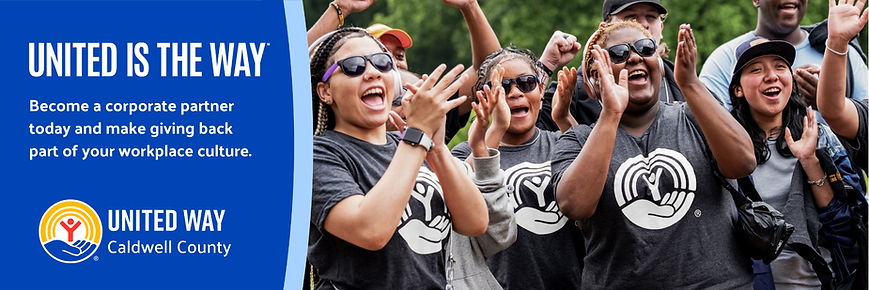
Are you a business owner, HR director, or executive looking for a way for your organization to give back to the community? Let us come to you.
The United Way provides a unique opportunity to engage all of your employees in charitable giving. We are happy to work with your team to discuss how easy payroll deductions are through our Workplace Campaigns. Contact us today to learn more.
We also accept In-Kind Giving opportunities. We invite you to strengthen our community through your business leadership. Corporate gifts demonstrate a company's commitment to social responsibility and to drive large scale impact to our 4 key impact areas: youth opportunity, healthy community, community resiliency, and financial security.
We invite you to partner with us and encourage a culture of philanthropy among employees. Let us help you build stronger connections to the community we serve.
Planned Giving
Making a planned gift to the United Way of Caldwell County is a rewarding and impactful way to make a lasting impact. Your legacy gift will impact generations to come and help us improve our community long term.
Name the United Way of Caldwell County in your will, as a beneficiary of your retirement plan, or on an existing or new life insurance policy. You can leave a legacy while gaining potential tax benefits.
The United Way has teamed up with FreeWill to make sure everyone in our community has access to a free will planning tool. Click here to complete your form online and include a gift intention to the United Way of Caldwell County.

A Donor Advised Fund (DAF) is another option where you can distribute gifts to numerous nonprofits. With a DAF, you can make gifts to charity during your lifetime and when you pass away, your children or you can grant all or a portion of the remaining balance to the United Way of Caldwell County to fulfill your philanthropic legacy. DAF funds give you the benefit from a more tax and cost efficient alternative to a private foundation and allows you to obtain a charitable income tax deduction in the year of your gift.
How a Donor Advised Fund Works: You make an initial, irrevocable gift of cash or stock to fund a DAF at a sponsoring organization. The assets in your DAF grow tax-free. You make annual recommendations on gifts to be made from your DAF.
IRA Distributions - If you are 70 1/2 or older, you can lower the income and taxes from your IRA withdrawals but opting for an IRA charitable rollover.
Life Insurance Policies - A gift of your life insurance policy that has outlasted its original purpose is another option to give. For example, you may have purchased a policy to provide for minor children and they are now financially independent adults.
Beneficiary Designations on Retirement Plans - To leave your retirement assets to the United Way of Caldwell County, you will need to complete a beneficiary designation form provided by your retirement plan custodian. If you designate us as your beneficiary, we will benefit from the full value of your gift because retirement assets will not be taxed at your death. Your estate will benefit from an estate tax charitable deduction for the gift.
Bequests - A bequest is one of the easiest gifts to make. With the help of an attorney, you can include language in your will or trust specifying a gift to be made to the United Way of Caldwell County as part of your estate plan, or you can make a bequest using a beneficiary designation form. See sample bequest language here.